Do short videos help people learn? What the research says
Mostly yes: short videos hold attention, and lessons split into meaningful segments are learned better. But short alone isn't enough. Here's the evidence.
By the Chasca team 7 min read
Short videos help people learn when each one is a complete, focused piece of a lesson. They hold attention far better than long videos, and lessons split into meaningful segments are remembered and applied better. But short isn’t automatically better: when the content is the same, test scores right after watching may barely differ, and a feed of unrelated short clips can even make memory worse. Here is what the research shows, and what it doesn’t.
If you are looking for a target length for a particular kind of video, see how long an explainer video should be. This article is about the evidence behind “short”.
Do people watch short videos to the end?
Much more often than long ones. What its authors described as the largest study of video engagement to date analyzed 6.9 million viewing sessions across four edX courses. Philip Guo, Juho Kim and Rob Rubin found that:
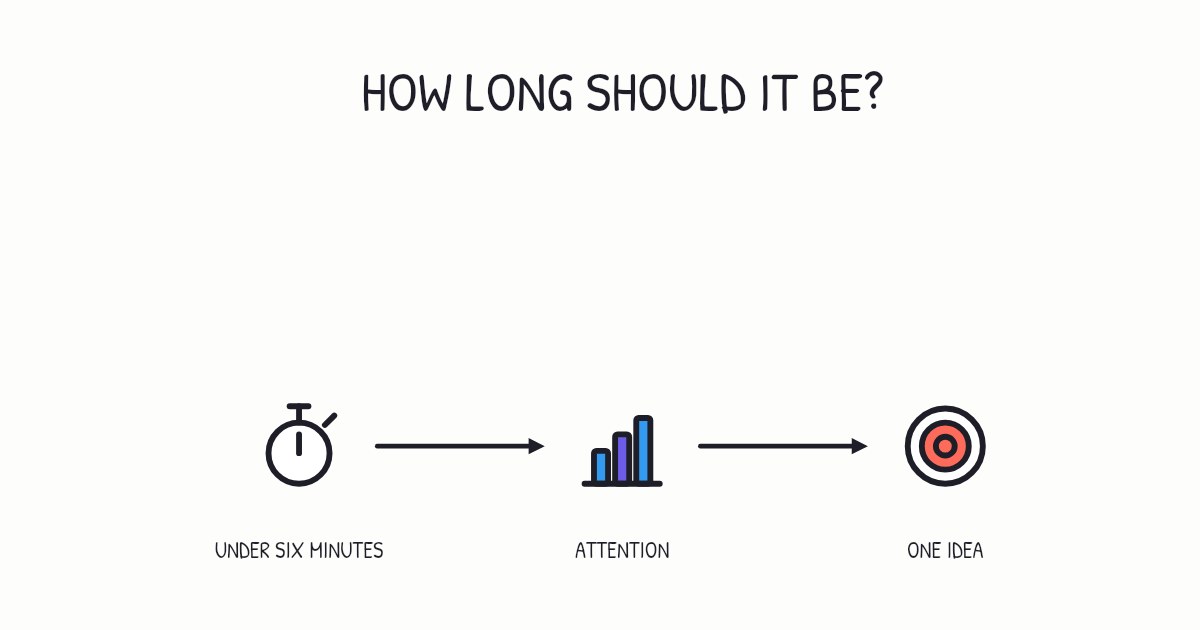
- Median engagement time was at most six minutes, however long the video was.
- Students often stopped before halfway through videos longer than nine minutes.
- The shortest videos held people best. For videos of three minutes or less, 75% of sessions lasted more than three quarters of the video.
- Fewer people tried the follow-up question after longer videos: 56% for the shortest group, falling to 31% for the longest.
The authors are clear about two limits. The study measures engagement (watching time and question attempts), not learning, which they describe as a prerequisite for learning rather than the same thing. And it looked back at four math and science courses; it was not a controlled experiment.
Why would shorter pieces be easier to learn from?
Because working memory is small. Nelson Cowan’s review of the research puts its capacity at about three to five meaningful chunks for young adults, so a long, unbroken explanation can ask people to juggle more than they can hold at once.
Cynthia Brame’s review of educational video research describes segmenting as a way to manage that load. Shorter videos, or chapters and questions inside a longer one, let viewers take in one small piece of new information at a time and decide when to move on to the next. That points to the real question: not whether a video is short, but whether each piece is small enough to take in and complete enough to make sense on its own.
Do shorter videos lead to better learning, or just more watching?
When researchers compare lengths directly, the gains from shortness alone look modest. In a study in two flipped middle school science classrooms, Krista Slemmons and colleagues compared long and short lecture videos. Test scores right after the videos were slightly higher after the short ones, but the difference was not significant. Longer-term retention was higher after short videos for male students and for students with learning disabilities, and students said they felt more engaged and focused with the short videos.
So short videos make it more likely that people watch, stay focused and come back. Whether they learn more depends on what happens inside each video and between them.
What does the research on segmenting show?
The stronger evidence is for segmenting: splitting a lesson into meaningful pieces that the learner moves through at their own pace. A meta-analysis of 56 studies by Günter Daniel Rey and colleagues found small to medium improvements in both retention and transfer (using what was learned on new problems), and lower cognitive load. Segmented lessons also took longer to work through, so part of the benefit may simply be extra time to process each piece.
Two details matter:
- The segments have to be meaningful. The effect is defined for “meaningful and coherent” segments, not arbitrary cuts every minute.
- The learner should control the pace. Reviewing a special issue of experiments on instructional video, Logan Fiorella and Richard Mayer listed segmenting with learner control among the features that improved learning, while simply inserting pauses throughout a video did not.
Do quizzes between short videos help?
Yes, and this may be where short videos earn most of their value. In a Harvard study, Karl Szpunar, Novall Khan and Daniel Schacter split a 21-minute recorded statistics lecture into four segments of about five and a half minutes. Students who took a short quiz after each segment reported mind wandering on 19% of checks, compared with 41% for students who did arithmetic between segments. They took more notes, and scored 90% on the final test against 68%.
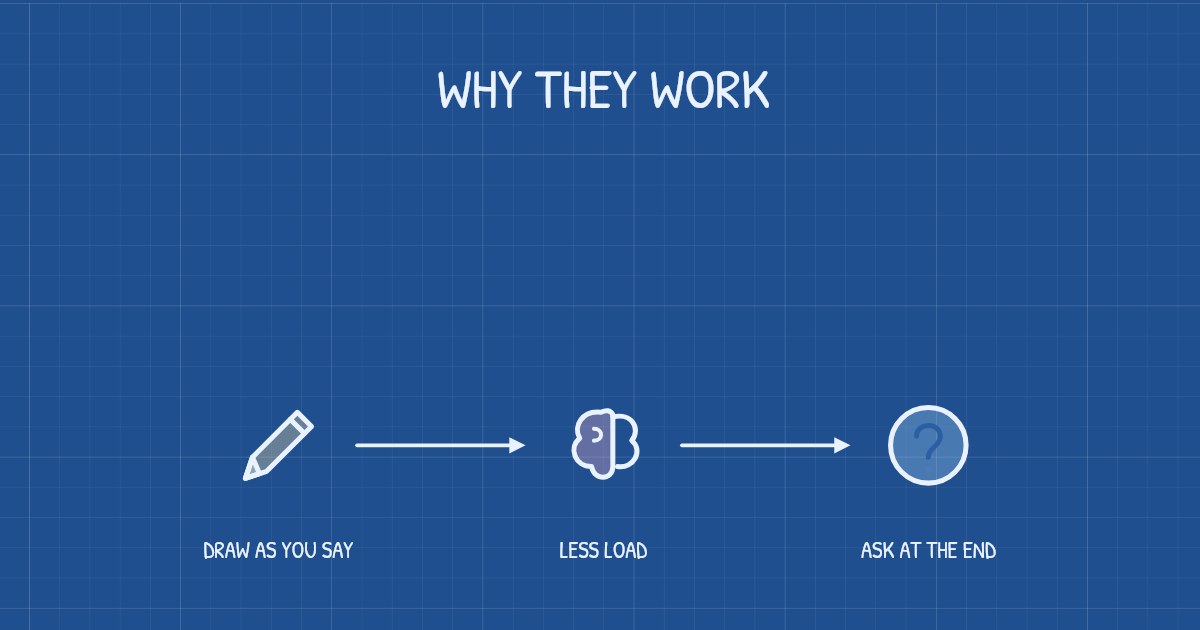
Short segments create natural places to ask a question. A long video rarely stops to ask anything. Recalling an answer is also what makes a question a better ending than a summary, which we cover in why whiteboard videos work.
Does microlearning work?
“Microlearning” usually means learning in small units, a few minutes at a time. The evidence is encouraging but thin. A 2019 scoping review of 17 studies in health professions education found positive effects on students’ knowledge and confidence. But the term has no agreed definition, and most studies measured how learners reacted (16 of 17) or what they knew afterwards (14 of 17). Only five looked at changes in behavior, and none measured results at the highest level of the evaluation model the reviewers used. They also noted downsides, including unequal access to technology and privacy concerns.
When is short not better?
- When it becomes a feed. In a 2023 experiment with 60 people, Francesco Chiossi and colleagues found that watching short TikTok videos impaired people’s memory for a task they had planned to do, while Twitter, YouTube and resting did not. The authors point to the combination of short videos and rapid switching between unrelated topics. A short lesson in a sequence is a different thing from an endless scroll.
- When a topic is chopped into fragments. Segments help when each one is a meaningful unit. Ten disconnected clips are not a lesson.
- When people come back to look something up. In Guo’s data, students watched tutorial videos for only two to three minutes whatever their length, but rewatched them more often than lectures. For how-to content, being easy to skim and rewatch matters more than being short.
What does this mean if you make videos?
- Explain one idea per video, and make a series for anything bigger.
- Stay under six minutes, and usually well under. Lengths by use case are in how long an explainer video should be.
- End each part with a question that viewers answer from memory.
- Make each part stand on its own, with its own start and end, so people can rewatch the one they need.
- Put the series in order, and say where each part fits.
For workplace training, our guide to making training videos puts all of this into steps, and making videos for an online course does the same for courses.
If you make videos with Chasca, the same ideas apply. It splits every video into scenes, each drawn in time with the narration, makes videos of up to 30 minutes on paid plans, told in chapters past six with a recap after each, and ends every video with a question. The examples page shows the results, and Chasca for education shows how teachers use it.
Sources
- Guo, P. J., Kim, J., & Rubin, R. (2014). How video production affects student engagement: An empirical study of MOOC videos. Proceedings of the ACM Conference on Learning at Scale.
- Cowan, N. (2010). The magical mystery four: How is working memory capacity limited, and why? Current Directions in Psychological Science, 19(1), 51–57.
- Brame, C. J. (2016). Effective educational videos: Principles and guidelines for maximizing student learning from video content. CBE Life Sciences Education, 15(4), es6.
- Slemmons, K., Anyanwu, K., Hames, J., Grabski, D., Mlsna, J., Simkins, E., & Cook, P. (2018). The impact of video length on learning in a middle-level flipped science setting: Implications for diversity inclusion. Journal of Science Education and Technology, 27, 469–479.
- Rey, G. D., Beege, M., Nebel, S., Wirzberger, M., Schmitt, T. H., & Schneider, S. (2019). A meta-analysis of the segmenting effect. Educational Psychology Review, 31, 389–419.
- Fiorella, L., & Mayer, R. E. (2018). What works and doesn’t work with instructional video. Computers in Human Behavior, 89, 465–470.
- Szpunar, K. K., Khan, N. Y., & Schacter, D. L. (2013). Interpolated memory tests reduce mind wandering and improve learning of online lectures. Proceedings of the National Academy of Sciences, 110(16), 6313–6317.
- De Gagne, J. C., Park, H. K., Hall, K., Woodward, A., Yamane, S., & Kim, S. S. (2019). Microlearning in health professions education: Scoping review. JMIR Medical Education, 5(2), e13997.
- Chiossi, F., Haliburton, L., Ou, C., Butz, A., & Schmidt, A. (2023). Short-form videos degrade our capacity to retain intentions: Effect of context switching on prospective memory. Proceedings of the 2023 CHI Conference on Human Factors in Computing Systems.
Video transcript What the narrator says in the 1:24 explainer above.
Do short videos help people learn? Mostly yes—when each is a complete, focused piece. Think of packing lunch: one complete meal per box, not scattered bites. Across 6.9 million viewing sessions in four edX courses, the shortest videos held attention best. But watching isn't learning.
Working memory is what you hold in mind right now. For young adults, it fits about three to five meaningful chunks. Pack one complete idea per lunchbox, and let viewers choose the next. A meta-analysis of 56 studies found better remembering and applying, though segmented lessons took longer.
In one classroom study, immediate scores barely differed by video length. Students quizzed between sections in a Harvard study scored 90% on the final test, against 68% for students doing arithmetic. Unrelated short clips can hurt memory. What makes a short lesson easier to learn? Complete parts you control and recall.
Questions people ask
They hold attention much better, and lessons split into meaningful segments that learners move through at their own pace are learned better. But when the content is the same, test scores right after watching may differ little, so short videos help most when each one is a complete, focused piece with a question at the end.
Under about six minutes. In 6.9 million viewing sessions on edX, median engagement was at most six minutes whatever the video's length, and students often stopped before halfway through videos longer than nine minutes. For a single idea, one to three minutes is usually enough.
The evidence is promising but thin. A 2019 scoping review of 17 studies in health professions education found positive effects on knowledge and confidence, but most studies measured how learners reacted and what they knew right afterwards rather than long-term behavior, and the term has no agreed definition.
A feed of them might. In a 2023 experiment with 60 people, watching short TikTok videos impaired memory for a task people had planned to do, while Twitter, YouTube and resting did not. The authors point to rapid switching between unrelated clips, which is different from watching a short lesson.