Why whiteboard videos work: what the research says
Drawing an idea as it is explained beats showing it finished. Eight research findings on whiteboard videos, and what each means for your next one.
By the Chasca team 5 min read
Whiteboard videos work because they build an idea in front of the viewer, one drawing at a time, in step with the narration. That lets people follow along instead of decoding a finished picture, and a small body of careful research backs it up. Here are eight findings worth knowing, and what each one means for the next video you make.
1. Drawing it beats showing it finished
In a 2023 pair of experiments, Sascha Schneider and colleagues showed 133 secondary school students the same narrated lesson two ways: with diagrams that were drawn progressively, stroke by stroke, or with the finished diagrams shown from the start. The progressive drawings led to better recall and better transfer, meaning students were better at applying what they learned to new questions.
For your video: don’t cut to a finished diagram. Let each part appear as it is explained.
2. The hand is optional
A second 2023 study tested whether the famous drawing hand matters. Florian Krieglstein and colleagues showed 84 university students a whiteboard animation in which pictures were drawn by a hand, pushed in by a hand, or appeared with no hand at all. A drawing hand made students more motivated than a pushing hand, but none of the three styles changed how much they learned.
For your video: a hand is a stylistic choice. The progressive drawing is what does the teaching.
3. Timing cues lighten the load
A picture that appears exactly when it is named works as a signpost: it tells the viewer where to look. A meta-analysis of cueing in multimedia learning by Heping Xie and colleagues, covering dozens of experiments and thousands of participants, found that cues improve retention and transfer, and that the more a cue reduces mental effort, the more it helps.
For your video: make every drawing, arrow and label land on the word that names it.
4. Short videos hold attention
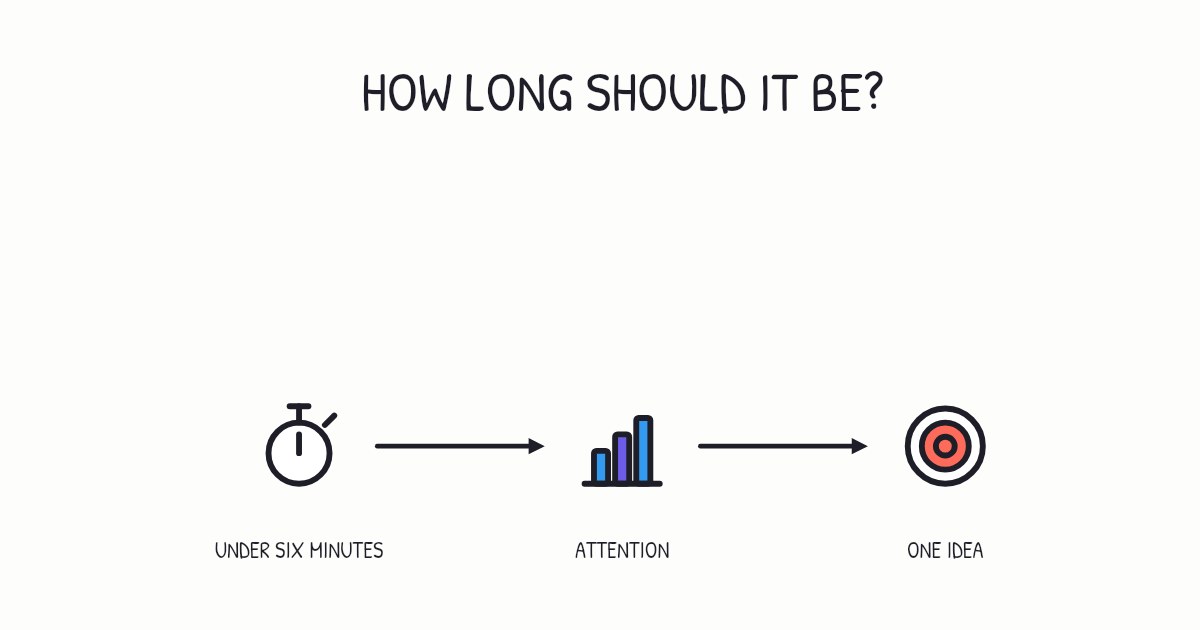
Philip Guo, Juho Kim and Rob Rubin analysed 6.9 million viewing sessions on edX and found that shorter videos were much more engaging. Their first recommendation was to plan lessons as chunks shorter than six minutes.
For your video: under six minutes for anything educational, and much shorter for a single idea. More on this in how long an explainer video should be.
5. Drawings beat slides
The same edX study compared production styles. Videos in which the instructor drew freehand on a tablet, the style Khan Academy popularised, kept students engaged longer than PowerPoint slides or code screencasts.
For your video: if you are choosing between bullet points and drawings, choose drawings.
6. Segments beat marathons
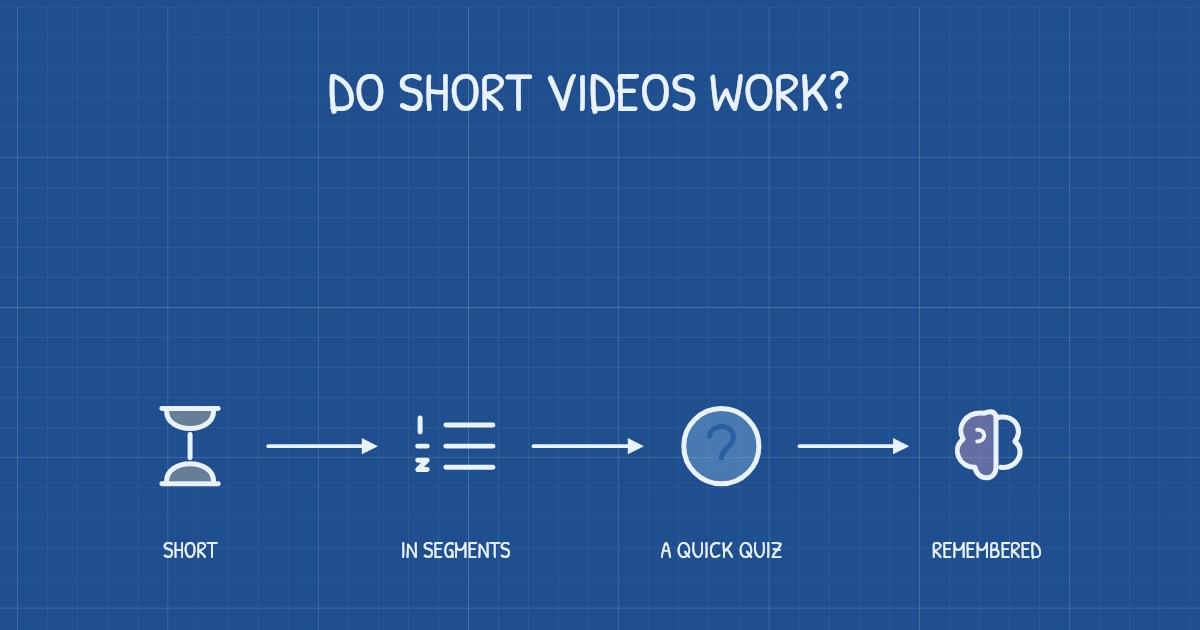
A meta-analysis of the segmenting effect by Günter Daniel Rey and colleagues pooled 56 studies and found that lessons presented in short, meaningful segments led to better recall and transfer, with lower mental effort, than the same material as one continuous stream. One explanation the authors examined is simply time: a break between segments gives people a moment to process what they just saw.
For your video: one idea per scene, with a beat of quiet after each before the next one starts.
7. Stories help understanding
In the same 2023 experiments as finding 1, wrapping the lesson in a narrative, with someone who wants something, an obstacle and a resolution, improved transfer and lowered perceived mental effort compared with a plain informative script.
For your video: where the topic allows, tell it as a story. “Maria’s savings grow while she sleeps” beats “compound interest is interest on interest”.
8. End with a question, not only a summary
Recalling an answer is one of the most reliable ways to make learning stick. In Henry Roediger and Jeffrey Karpicke’s classic experiments on the testing effect, students who practised recalling a passage remembered substantially more a week later than students who spent the same time rereading it. Self-testing is also one of the eight strategies in Logan Fiorella and Richard Mayer’s review of generative learning.
For your video: close with a question the viewer answers in their head, a short pause, then a one-line answer.
One more thing: leave out the decoration
“Seductive details” are interesting but irrelevant extras: a fun fact, a decorative picture, a joke that takes a detour. Rey’s 2012 meta-analysis of the seductive detail effect found that such extras reduce both recall and transfer, especially when they are visual.
For your video: if the narration doesn’t mention it, don’t draw it.
A checklist for your next explainer
- One idea per scene, each scene 10 to 30 seconds.
- Every drawing appears on the word that names it.
- Nothing on screen that the narration doesn’t mention.
- A story or an everyday comparison before the technical terms.
- Under six minutes in total, or split into a series.
- A question at the end, a pause, then the answer.
Chasca builds every video along these lines, from a one-line prompt or a document. See how the finished result looks on the examples page.
Sources
- Schneider, S., Krieglstein, F., Beege, M., & Rey, G. D. (2023). Successful learning with whiteboard animations: A question of their procedural character or narrative embedding? Heliyon.
- Krieglstein, F., Meusel, F., Rothenstein, E., Scheller, N., Wesenberg, L., & Rey, G. D. (2023). How to insert visual information into a whiteboard animation with a human hand? Effects of different insertion styles on learning. Smart Learning Environments.
- Xie, H., et al. (2017). The more total cognitive load is reduced by cues, the better retention and transfer of multimedia learning: A meta-analysis and two meta-regression analyses. PLOS ONE, 12(8).
- Guo, P. J., Kim, J., & Rubin, R. (2014). How video production affects student engagement: An empirical study of MOOC videos. Proceedings of the ACM Conference on Learning at Scale.
- Rey, G. D., Beege, M., Nebel, S., Wirzberger, M., Schmitt, T. H., & Schneider, S. (2019). A meta-analysis of the segmenting effect. Educational Psychology Review, 31, 389–419.
- Roediger, H. L., & Karpicke, J. D. (2006). Test-enhanced learning: Taking memory tests improves long-term retention. Psychological Science, 17(3), 249–255.
- Fiorella, L., & Mayer, R. E. (2016). Eight ways to promote generative learning. Educational Psychology Review, 28(4), 717–741.
- Rey, G. D. (2012). A review of research and a meta-analysis of the seductive detail effect. Educational Research Review, 7(3), 216–237.
Video transcript What the narrator says in the 1:26 explainer above.
Why do whiteboard videos work? They draw ideas as they’re explained, so you follow along instead of decoding a finished picture. It’s like assembling a jigsaw puzzle as each piece is named. In a 2023 pair of experiments, 133 secondary school students had better recall and transfer with progressive diagrams.
A drawing hand can raise motivation over a pushing hand, but doesn’t change learning. Add each puzzle piece when its name is spoken: timing cues can reduce mental effort. Keep lessons shorter than six minutes, draw instead of showing slides, give ideas separate scenes, and use a story when it fits.
Finally, end with a question, not just a summary: practicing recall helped students remember more a week later than rereading. Leave out tempting extras, especially decorative pictures; they can reduce recall and transfer. Why does drawing in sync help? You follow each piece instead of decoding everything.
Questions people ask
Yes. In a 2023 experiment with 133 students, diagrams drawn progressively during the narration led to better recall and better understanding than the same diagrams shown finished. The drawing, not the hand, is what makes the difference.
For holding attention, yes. In 6.9 million viewing sessions on edX, videos drawn freehand on a tablet kept students watching longer than PowerPoint slides.
Because recalling an answer strengthens memory more than rereading or rewatching. In the classic testing-effect experiments, students who practised recall remembered substantially more a week later than students who studied the material again.