Why maths students need worked solutions, not just answers
Students new to a topic learn more from worked solutions than from solving alone. The evidence, what a good solution video shows, and how to make one.
By the Chasca team 7 min read
Students meeting a new kind of maths problem learn more by studying a worked solution, with every step written down and explained, than by struggling through the problem alone. Yet most homework comes with an answer key at best, and a patient explanation of tonight’s exact question, in the student’s own language, is still something many families pay a tutor for.
Why does a worked solution teach more than an answer?
Because a beginner solving a problem cold spends most of their effort searching for a method instead of learning one. In the experiments that first described the worked-example effect, John Sweller and Graham Cooper found in 1985 that algebra students who studied worked examples then solved similar problems faster and with fewer errors than students who had solved the same problems themselves.
Decades of follow-up studies agree. A 2023 meta-analysis by Christina Areizaga Barbieri and colleagues pooled 55 studies of maths learners from primary school to university and found a medium average benefit from worked examples (g = 0.48), whether they were used to introduce a skill or for practice.
An answer on its own does much less. In 2013 experiments with university students learning from short texts, Andrew Butler, Namrata Godbole and Elizabeth Marsh found that feedback explaining why an answer was right led to better scores on new questions two days later than feedback giving only the right answer. On repeated questions the two did equally well: the explanation is what carried over.
How many students need this kind of help?
A great many. In the OECD’s PISA 2022 assessment of 15-year-olds in 81 countries and economies, 31% of students across OECD countries scored below the baseline level of proficiency in mathematics. Anxiety travels with it: in every education system that took part, students who were more anxious about maths scored lower, even after accounting for their socio-economic background.
Families who can, pay for help. India’s 2025 national survey of school education, covering 57,742 students, found that 27% were taking or had taken private coaching that school year, 30.7% in urban areas, with average spending on coaching rising from ₹525 a student in pre-primary to ₹6,384 in higher secondary. UNESCO’s 2021/2 Global Education Monitoring Report finds that demand for private tutoring is most closely tied to preparing for high-stakes exams.
Where does homework help break down today?
- Answer keys tell a student whether they were right, not where they went wrong.
- Tutors find the missing step, but cost money every week.
- Teachers know a worked example helps, but writing or filming one for every question on every sheet is hours of work on top of a full timetable.
- Online videos explain topics well, but the chance that someone has solved tonight’s exact question, at the right level and in the student’s language, is small.
Language matters more than it looks. The World Bank estimates that 37% of students in low- and middle-income countries aren’t taught in the language they speak and understand best, and its 2021 policy approach recommends teaching subjects beyond reading and writing in a student’s first language too.
What does a good worked solution video need?
Research on learning from examples and from multimedia points to a short list. Robert Atkinson and colleagues’ 2000 review of the worked-examples research recommends examples whose parts are integrated, whose structure is labelled or broken into steps, and which sit close to matching practice problems. Paul Ginns’ 2006 meta-analysis of 50 studies found that bringing related information together, in space and in time, gives substantial learning gains, especially with complex material. In practice, that means:
- Keep the question in view, so the student never has to remember it while reading the working.
- One step per line, said as it appears, so the line and its explanation arrive together.
- Give every step its reason. “Subtract 3 from both sides” teaches; “2x = 14” alone doesn’t.
- Say why the tempting wrong answer is wrong, because that’s the mistake most students are about to make.
- Box the answer, then practise. Put a similar problem next to the video for the student to solve alone.
Drawing as you explain helps too; we summarise that research in why whiteboard videos work.
What does the Maths problems skill do?
We make Chasca, so take our part of this with that in mind. We built the Maths problems skill for one job: solving the questions on your own sheet the way you would at the board.
You type or paste the problems, with their options and your answer key if you have them, or add photos, a PDF or a document of the sheet, up to 20 pages. Name a topic and a level instead, and it writes exam-style problems for you. Then:
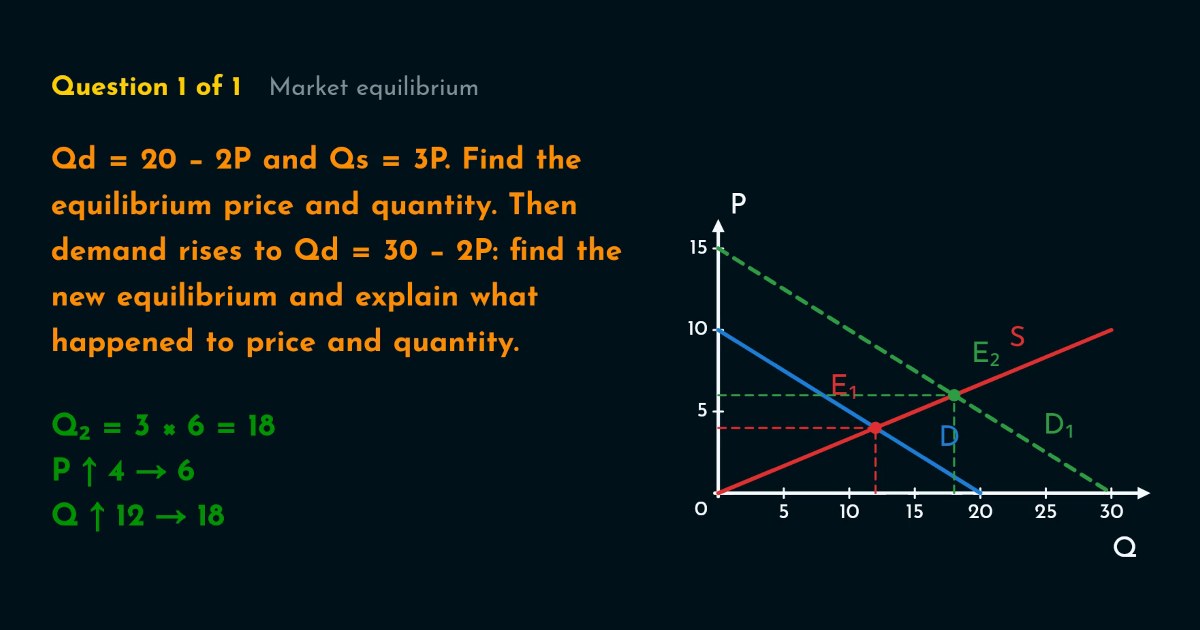
- The problem goes on the board first, read word for word with a pointer under it, and each option appears as it is named.
- The working is written one line at a time as it is said, and the answer is boxed or the right option marked. A result never appears before the narrator says it, and the captions follow the same rule.
- Every answer is solved a second time, separately, before the video is drawn, and checked against your key if you gave one. Your key stays the answer: if anything disagrees, the video is still made, and its page tells you which question to check before you share it.
- The narration is worded the way teachers of your language explain maths, from how a square is read aloud to how options are named, in any of 30 narrators or your own voice. Paste your own explanation and it’s read word for word.
- Arabic runs right to left, with Arabic-Indic digits kept exactly as your questions write them (Arabic maths).
- The video follows the questions, from one minute up to 30 on a paid plan, in 16:9 on a black board or a whiteboard.
Who is it for?
Teachers who want a solution video for each homework question, tutors and coaching centres turning question banks into worked solution sets, and channels that publish solved problems in their students’ language. It suits students meeting a topic for the first time. Once they can solve a type of problem reliably, studying examples helps less and practice helps more: in 2001, Slava Kalyuga and colleagues found that mechanical trade apprentices with more experience learned more from solving problems than from studying worked examples, the reverse of what worked for beginners.
What won’t it do?
- Guess. If an answer can’t be checked, you’re told which question to look at instead.
- Skip steps a student needs to follow the working.
- Draw figures. Geometry diagrams and graphs aren’t drawn on this board yet, so a problem that hinges on its figure is better taught another way.
- Replace practice. A worked solution starts the learning; the student still has to solve the next one alone.
How do you make one?
- Open Maths problems in Chasca and type or paste the problems, or add photos or a PDF of the sheet.
- Add the options and your answer key if you have them.
- Pick the language, the voice and the board, then make the video.
- Check the video’s page for any flagged question before you share it, and post the video next to a practice problem.
Your first two videos are free, up to a minute each, watermarked and with no card required; a free video solves the first questions that fit in its minute and tells you what was left. Plans start at $9.99 a month (pricing).
Sources
- Sweller, J., & Cooper, G. A. (1985). The use of worked examples as a substitute for problem solving in learning algebra. Cognition and Instruction, 2(1), 59–89.
- Barbieri, C. A., Miller-Cotto, D., Clerjuste, S. N., & Chawla, K. (2023). A meta-analysis of the worked examples effect on mathematics performance. Educational Psychology Review, 35, 11.
- Butler, A. C., Godbole, N., & Marsh, E. J. (2013). Explanation feedback is better than correct answer feedback for promoting transfer of learning. Journal of Educational Psychology, 105(2), 290–298.
- OECD (2023). PISA 2022 Results (Volume I): What can students do in mathematics, reading and science?
- OECD (2023). PISA 2022 Results (Volume I): How did countries perform in PISA? Box I.2.1, mathematics anxiety.
- Ministry of Statistics and Programme Implementation, Government of India (2025). Results of Comprehensive Modular Survey: Education, 2025.
- UNESCO (2021). Global Education Monitoring Report 2021/2: Non-state actors in education.
- World Bank (2021). Teaching young children in the language they speak at home is essential to eliminate Learning Poverty, on Loud and Clear: Effective Language of Instruction Policies for Learning.
- Atkinson, R. K., Derry, S. J., Renkl, A., & Wortham, D. (2000). Learning from examples: Instructional principles from the worked examples research. Review of Educational Research, 70(2), 181–214.
- Ginns, P. (2006). Integrating information: A meta-analysis of the spatial contiguity and temporal contiguity effects. Learning and Instruction, 16(6), 511–525.
- Kalyuga, S., Chandler, P., Tuovinen, J., & Sweller, J. (2001). When problem solving is superior to studying worked examples. Journal of Educational Psychology, 93(3), 579–588.
Video transcript What the narrator says in the 2:07 explainer above.
In this video, we solve two questions on average speed and the area of a triangle.
Question one. A train travels one hundred and eighty kilometres in two hours fifteen minutes. What is its average speed in kilometres per hour? Option A, seventy-two. Option B, eighty. Option C, ninety. Option D, eighty-five.
Let us solve it. Average speed equals total distance divided by total time, so you must first express the time in hours.
First, convert two hours fifteen minutes to hours: two plus fifteen over sixty equals two point two five hours.
Now divide one hundred and eighty by two point two five to get eighty kilometres per hour.
As a check, eighty multiplied by two point two five gives one hundred and eighty kilometres, matching the distance travelled.
Hence, the correct answer is option B, eighty kilometres per hour.
Question two. Find the area of a triangle with sides thirteen centimetres, fourteen centimetres and fifteen centimetres.
Let us solve it. Use Heron's formula: with semiperimeter s, the area equals the square root of s times s minus a times s minus b times s minus c.
First, the semiperimeter is thirteen plus fourteen plus fifteen, divided by two, which equals twenty-one centimetres.
Subtracting each side from twenty-one gives eight, seven, and six centimetres.
So the area is the square root of twenty-one times eight times seven times six.
Multiplying inside the square root gives seven thousand and fifty-six.
Taking the square root gives eighty-four square centimetres. As a check, eighty-four squared is seven thousand and fifty-six, matching the product under the square root.
Hence, the area of the triangle is eighty-four square centimetres.
Questions people ask
Yes, especially when a topic is new. A 2023 meta-analysis of 55 studies, with learners from primary school to university, found a medium average benefit from studying worked examples. Once a student can solve a type of problem reliably, practice helps more.
Rarely. An answer key shows whether a student was right, not where their working went wrong. In 2013 experiments, feedback that explained the answer led to better results on new questions than feedback that only gave the right answer.
Show the problem and keep it in view, write one step per line as you explain it, give each step its reason, and box the answer. Chasca's Maths problems skill makes that video from typed problems or a photo of the sheet.
Yes. Add photos, a PDF or a document of the sheet, up to 20 pages, and the Maths problems skill reads the questions from it. Check the questions in the finished video against your sheet before you share it.
Every answer is solved a second time, separately, before the video is drawn, and checked against your answer key if you give one. If anything disagrees, the video's page tells you which question to check before you share it.
Yes. The narration is written the way teachers of that language explain maths, and Arabic working runs right to left, with Arabic-Indic digits kept when your questions use them.