Teachers and tutors
Show the idea before the exercises: why a ball at 45° goes farthest, why a block on a ramp speeds up, how a lens makes an image. For GCSE, A-level, IB, AP, JEE and NEET.
Skills Visual physics
Ask about a physics idea, ask a question or paste your notes, and Chasca makes a narrated video that shows it happening: a ball that flies and leaves a dot every quarter second, forces drawn on a block at their true sizes, a mass on a spring with its graph tracing itself beside it, rays that bend through a lens and meet where the image forms, charges flowing round a circuit as fast as their current. Every motion is worked out from real numbers, and each equation writes itself in beside the picture, its parts in the colours of the arrows and bodies they describe.
At a glance
Who it’s for
Show the idea before the exercises: why a ball at 45° goes farthest, why a block on a ramp speeds up, how a lens makes an image. For GCSE, A-level, IB, AP, JEE and NEET.
Ask about the topic you are stuck on and watch it happen with real numbers, in your language, as many times as you need.
Publish physics explainers in one consistent style, without animating every scene by hand or coding a simulation.
How it works
A topic, a question like “why does a ball thrown at 45° go farthest?”, your notes or your own script, in any language.
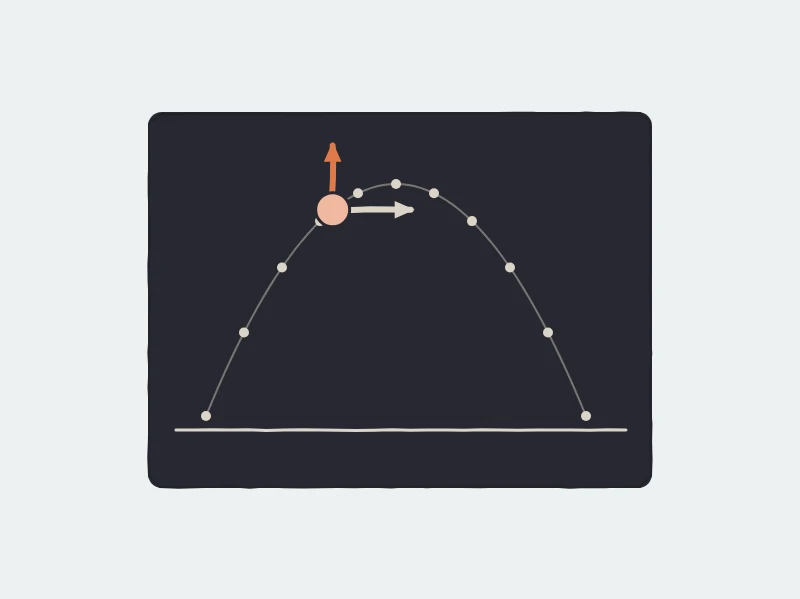
Paths, swings, orbits, currents and rays are worked out from real numbers, so what moves on screen is what the physics predicts.
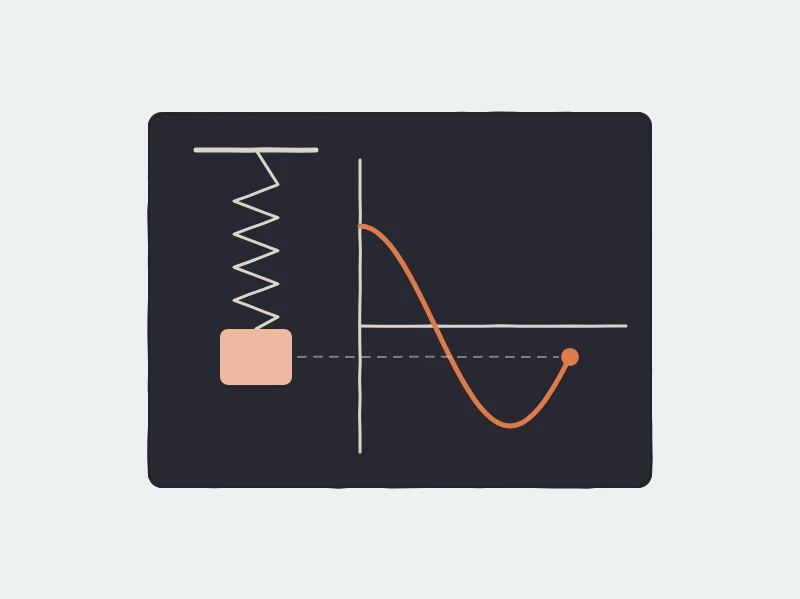
A position or energy graph traces itself beside the motion, forces are drawn to scale, and the moment it clicks is held still.
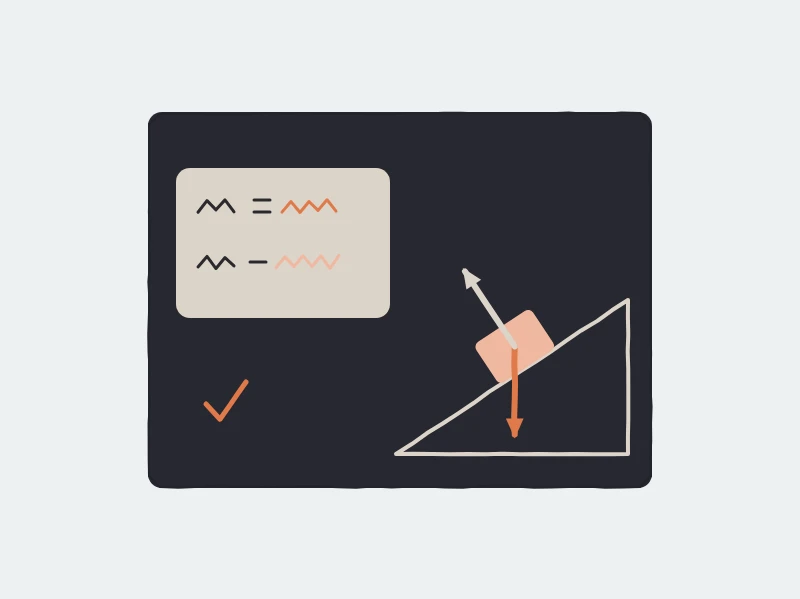
Each equation writes itself in beside the diagram, every term coloured like the arrow, ray or body it names.
Examples
A ball launched at 45° and 20 m/s, its two velocities plotted beside it as it flies; then 30° and 60° landing together, and range against angle peaking at 45°.
PromptWhy does a ball thrown at 45 degrees go the farthest? Show its path, its velocity in two parts, and how the range changes with the angle.
Made from a promptVisual physicsEnglish
A 2 kg block on a 30° ramp with friction: its weight split along and across the slope, each force drawn to scale, and the acceleration worked out, in Spanish.
PromptExplica las fuerzas sobre un bloque de 2 kg en un plano inclinado de 30 grados con rozamiento, y por qué acelera.
Made from a promptVisual physicsSpanish
A mass on a spring with its position traced as a cosine beside it, then energy bars that pass the same two joules between the spring and the mass.
PromptSimple harmonic motion: a mass on a spring, its position against time, and how the energy moves between the spring and the mass.
Made from a promptVisual physicsEnglish
Ray diagrams for a convex lens, drawn ray by ray: the object beyond 2F, then inside F, with the image where the rays meet, in Hindi.
Promptउत्तल लेंस से प्रतिबिंब कैसे बनता है? वस्तु को 2F से आगे और फिर F के अंदर रखकर किरण आरेख बनाइए।
Made from a promptVisual physicsHindi
Series and parallel circuits for GCSE: the current split at a junction, ammeter and voltmeter readings worked out, and charges flowing as fast as their current.
PromptSeries and parallel circuits for GCSE: why do bulbs in parallel stay bright? Show the current splitting, with an ammeter and a voltmeter.
Made from a promptVisual physicsEnglish
A sample of 100 nuclei decaying, exactly half of what is left each half-life, with the decay curve traced beside it, in Arabic.
Promptما هو عمر النصف؟ اشرح التحلل الإشعاعي بعينة من ١٠٠ نواة ومنحنى التحلل.
Made from a promptVisual physicsArabic
Why we built it
The best physics animations online are made by hand or coded scene by scene, and one good video can take days. Most teachers and students never have that time, so the explanation of the topic they are stuck on is a still diagram in a textbook, or a video in someone else’s language. We built Visual physics so that any physics idea, in any language, can be seen moving the way it really moves.
Yes. Chasca’s Visual physics skill makes a narrated video that explains a physics idea with diagrams worked out from real numbers: projectiles and their paths, forces on a block on a ramp, springs and pendulums with their graphs, waves, ray diagrams for lenses and mirrors, circuits, field lines, orbits, gases, the photoelectric effect and half-life. Equations write themselves in beside the picture, coloured like the objects they describe. You type a topic or a question, or paste your notes or your own script.
Motion and its graphs, free-body diagrams, projectiles, circular motion, energy and momentum, collisions, simple harmonic motion, waves (transverse, longitudinal, interference, standing), optics (mirrors, lenses, refraction, total internal reflection, prisms), circuits (current, voltage, Ohm’s law, series and parallel, meters), electric and magnetic fields, gravitation and orbits, gases, and modern physics (the photoelectric effect, energy levels, half-life).
Yes. Every motion is computed from its numbers rather than drawn from a description: a projectile follows its parabola, a pendulum swings as its equation says at any angle, an orbit is an ellipse with the planet fastest near its star, rays meet where the lens formula puts the image, and every current in a circuit is solved. The script is checked against those results before the video is made, and the video’s page tells you if anything needs a look.
Science problems solves exam questions on a teacher’s board, line by line, with a figure beside the working. Visual physics explains how a physical system behaves and why, with diagrams that move and graphs drawn as they move. Use Science problems for a worksheet and Visual physics for the idea behind it.
Yes. Pick “My words, word for word” and paste your script: every word is narrated as written, and the skill adds the diagrams and the equations, timed to your words. Or paste your notes and let it write the explanation.
All 79 languages Chasca narrates in. Numbers and units are read the way teachers of that language say them, the words on screen are in that language, and in Arabic the words run right to left.
From one minute to 10 minutes on a paid plan; the free videos are up to a minute.
Your first 2 videos are free, up to 1 minute each, watermarked. No card required. A skill works on the free videos too, up to a minute. After that, plans start at $9.99 a month for 30 minutes. See pricing.
More skills
Physics, chemistry and genetics problems, units on every line and the diagram drawn beside.
Maths ideas shown moving: grids that transform, graphs that morph, equations in the picture’s colours.
Problems solved step by step on a teacher’s board, with a pointer and the answer boxed.
Your first 2 videos are free, up to 1 minute each, watermarked. No card required. Full product, every voice and style included.