Chemistry teachers and tutors
Show what the particles do before the exercises: why water is bent, how HBr adds to an alkene, what happens at the equivalence point.
Skills Visual chemistry
Ask about a molecule, a reaction or a topic, or paste your own script, and Chasca makes a narrated video that shows what the particles do: water turning in 3D with its lone pairs and its 104.5° angle, curly arrows pushing electrons as bonds break and form, an equation that balances itself over an atom count, a titration curve that leaps as the indicator turns pink. Every structure is worked out from its formula and every equation is balanced exactly before it is drawn.
At a glance
Who it’s for
Show what the particles do before the exercises: why water is bent, how HBr adds to an alkene, what happens at the equivalence point.
GCSE, A-level, AP, IB, NEET, JEE or first-year chemistry: ask about the shape or the reaction you are stuck on and watch it built up step by step, in your language.
Publish chemistry explainers in one consistent style, without modelling molecules by hand or learning 3D software.
How it works
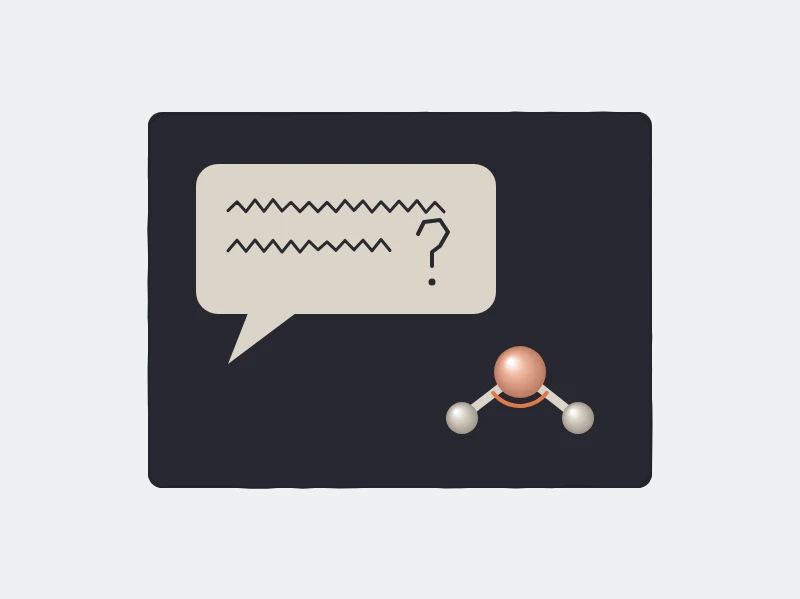
Type a topic, a question like “why is water bent?”, an equation to balance or a mechanism, or paste your own script, in any language.
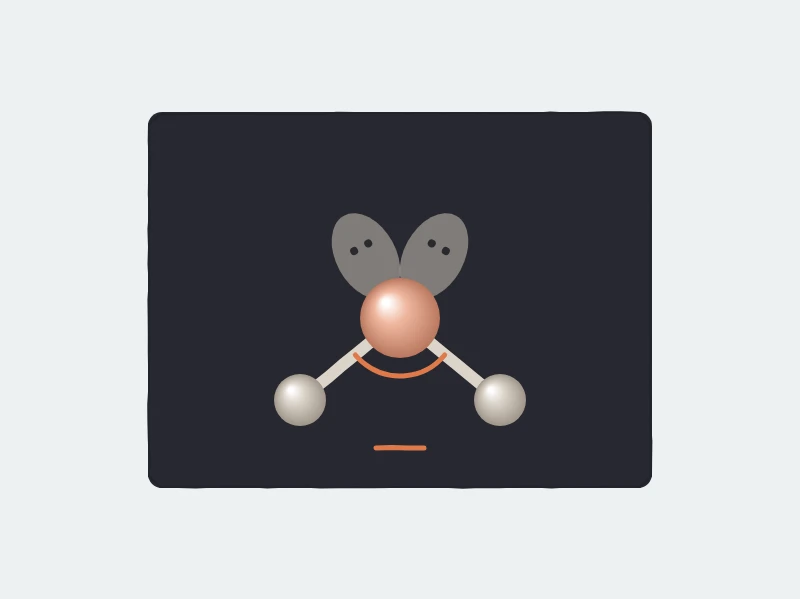
Each molecule is worked out from its formula and drawn in 2D or turned in 3D, with its real bond angles and lone pairs.
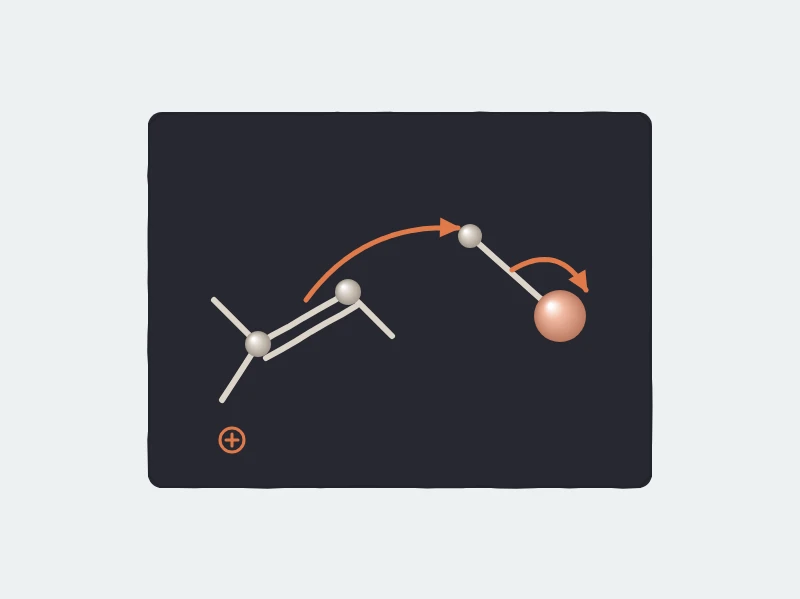
Curly arrows push electrons as bonds break and form, equations balance with an atom count, particles melt and boil, curves are calculated.
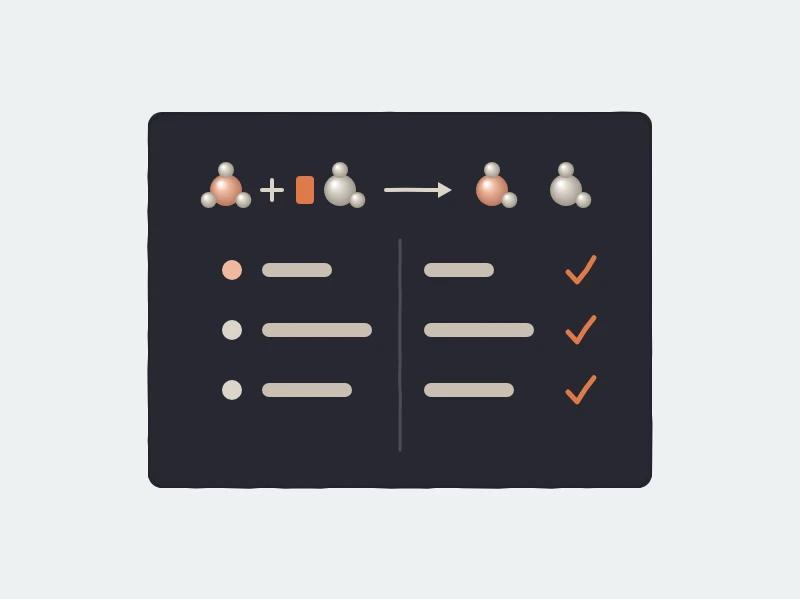
Coefficients are worked out exactly, every arrow’s electrons are counted, and the script is read for mistakes before you share it.
Examples
A water molecule turning in 3D: two bonds and two lone pairs spread around the oxygen, and the lone pairs squeeze the bond angle from 109.5° to 104.5°.
PromptWhy is water a bent molecule? Show its shape in 3D with the lone pairs and the bond angle.
Made from a promptVisual chemistryEnglish
Propane burning in oxygen, balanced element by element over an atom tally: three CO₂ for the carbon, four H₂O for the hydrogen, then five O₂, changing coefficients and never formulas.
PromptBalance the combustion of propane step by step, with an atom count for each element.
Made from a promptVisual chemistryEnglish
Curly arrows push each electron pair as HBr adds to propene: the more stable secondary carbocation forms, bromide attacks it, and 2-bromopropane is the major product.
PromptShow the mechanism of the electrophilic addition of HBr to propene with curly arrows, and why the major product is 2-bromopropane.
Made from a promptVisual chemistryEnglish
A weak-acid titration explained in Spanish: ethanoic acid against sodium hydroxide, the pH curve drawn as it is measured, pH = pKa at half equivalence, a basic equivalence point near 8.7 and why phenolphthalein fits.
PromptValoración de ácido etanoico con hidróxido de sodio: la curva de pH, el punto de equivalencia y el indicador.
Made from a promptVisual chemistrySpanish
How a Daniell cell makes electricity, explained in Arabic and written right to left: zinc is oxidised, copper ions are reduced, electrons flow through the wire and the salt bridge keeps the charges balanced, about 1.10 V.
Promptكيف تعمل الخلية الجلفانية؟ اشرح خلية دانيال من الخارصين والنحاس وحركة الإلكترونات.
Made from a promptVisual chemistryArabic
Periodic trends in atomic radius, explained in Hindi: atoms drawn to one scale shrink from sodium to chlorine as the nucleus pulls harder, and grow down the group to potassium as a new shell is added.
Promptआवर्त सारणी में परमाणु त्रिज्या: आवर्त में बाएँ से दाएँ घटती क्यों है और समूह में नीचे जाने पर बढ़ती क्यों है?
Made from a promptVisual chemistryHindi
Why we built it
The best chemistry animations online are built by hand in 3D software, one reaction at a time, and most topics never get one, let alone in Hindi, Arabic or Spanish. Teachers end up drawing curly arrows on a whiteboard and asking students to imagine the rest. We built Visual chemistry so that any molecule or reaction, in any language, can be shown moving and shown right.
Yes. Chasca’s Visual chemistry skill makes a narrated video that explains chemistry with molecules and reactions that move: structures in 2D and 3D, curly arrows in mechanisms, equations balanced step by step, particles, the periodic table, titration curves and lab set-ups. You type a topic or a question, or paste your own script.
Structures and bonding (skeletal, displayed and Lewis formulas, 3D shapes and VSEPR), reaction mechanisms with curly arrows, balancing equations, moles and reacting masses, states of matter, periodic trends, acids, bases and titrations, energy profiles and catalysts, electrochemical cells and electrolysis, and organic functional groups.
Every structure is worked out from its formula and checked for impossible bonds before it is drawn, every equation is balanced by calculation, every curly arrow is checked electron by electron, and titration curves and cell voltages are calculated. The script is read for mistakes too, and the video’s page tells you if anything needs a look.
Science problems solves exam questions on a teacher’s board, line by line, with units on every line. Visual chemistry explains why: what the molecules and electrons do, with moving pictures. Use Science problems for a worksheet and Visual chemistry for the idea behind it.
Yes. Pick “My words, word for word” and paste your script: every word is narrated as written, and the skill adds the molecules, equations and graphs, timed to your words.
All 79 languages Chasca narrates in. Formulas and equations stay as chemists write them everywhere, and in Arabic the words run right to left.
From one minute to 10 minutes on a paid plan; the free videos are up to a minute.
Your first 2 videos are free, up to 1 minute each, watermarked. No card required. A skill works on the free videos too, up to a minute. After that, plans start at $9.99 a month for 30 minutes. See pricing.
More skills
Physics, chemistry and genetics problems, units on every line and the diagram drawn beside.
Maths ideas shown moving: grids that transform, graphs that morph, equations in the picture’s colours.
Problems solved step by step on a teacher’s board, with a pointer and the answer boxed.
Your first 2 videos are free, up to 1 minute each, watermarked. No card required. Full product, every voice and style included.