Why seeing molecules move helps chemistry make sense
Chemistry is hard because it happens at a level nobody can see. The evidence on animations of molecules and reactions, and what a good one needs.
By the Chasca team 6 min read
Chemistry is hard to learn because it happens at a level nobody can see. A student watches a colourless solution turn pink, reads an equation with arrows and subscripts, and is asked to imagine the molecules in between. Research on teaching chemistry backs what good teachers already do: show the particles, move between what you see and the symbols, and slow down at the moment that matters. Animation helps when it does exactly that, and when what it draws is chemically right.
Why is chemistry so hard to learn?
Alex Johnstone gave the best-known answer in 1991, in a paper titled Why is science difficult to learn? Things are seldom what they seem. Chemistry is explained on three levels at once: the macroscopic (what you see and measure), the sub-microscopic (atoms, molecules, ions, electrons) and the symbolic (formulas, equations, curly arrows). Experts move between the three without noticing. Novices are asked to do the same in the space of one sentence, and the load is more than working memory can carry.
Dorothy Gabel’s review of two decades of chemistry education research made the consequence plain: in many students’ minds there is no connection between the three levels. A balanced equation can be manipulated without any picture of the particles it describes, and an observation in the lab can be described without any idea of what the particles are doing.
Do animations of molecules help?
On the evidence, mostly yes, when they show the particles doing what the explanation says.
- College students: Vickie Williamson and Michael Abraham found that students who saw computer animations of the particulate nature of matter built better particle models of chemical phenomena than students taught with still pictures alone.
- School students: Dilek Ardac and Sevil Akaygun taught 49 eighth graders either with multimedia that put molecular animations beside real observations and symbols, or in the usual way. The multimedia group scored higher and found it easier to draw matter at the molecular level. The long-term results suggested the gain would be stronger still with prompts that make students link each representation to the others.
- First-year chemistry: Roy Tasker and Rebecca Dalton describe a semester of teaching built around the VisChem molecular animations: the first-year students’ drawings of chemical phenomena showed significantly more scientifically acceptable features by the end of it.
- Across subjects: Tim Höffler and Detlev Leutner’s meta-analysis of 26 studies found instructional animations beat static pictures on average (d = 0.37), and by more when the animation showed the content itself rather than decorating it.
When does an animation not help?
When it is decorative, too fast or wrong. Tasker and Dalton found that students also take away what an animation gets wrong or leaves out: some came to see reactions as more orderly and mechanical than they are, missing the randomness of real particles. They stress that an animation has to sit inside a learning design that tells students what to look for and links it to what they already know, which is the same point Ardac and Akaygun’s long-term results make.
Three conditions follow:
- Show the particles doing exactly what the narration says, at the moment it says it, not a generic swirl of balls.
- Give the important change time, and hold still after it.
- Keep the symbol on screen and link it to the particles, so the equation becomes a description of something the viewer has watched.
Why should curly arrows move?
Because students so often treat them as decoration. Gautam Bhattacharyya and George Bodner interviewed chemistry graduate students about mechanisms and found that many used curly arrows as a way to get to a product they already knew, rather than as a model of electrons moving; the title quotes one of them: “It gets me to the product”. Nathaniel Grove, Melanie Cooper and Kelli Rush found the same pattern in undergraduates, who often drew the product first and then decorated the reaction with arrows.
An animation can show what a static mechanism only implies: the arrow appears first, starting from a real pair of electrons, and then the bond it points at forms, the bond it starts from breaks, and the charges move. Seen that way, the arrow is the cause of the change, not a label on it. That only works if every arrow is chemically valid: an arrow from a carbon with no lone pair, or a carbon left with five bonds, teaches exactly the wrong thing.
Why the chemistry has to be computed
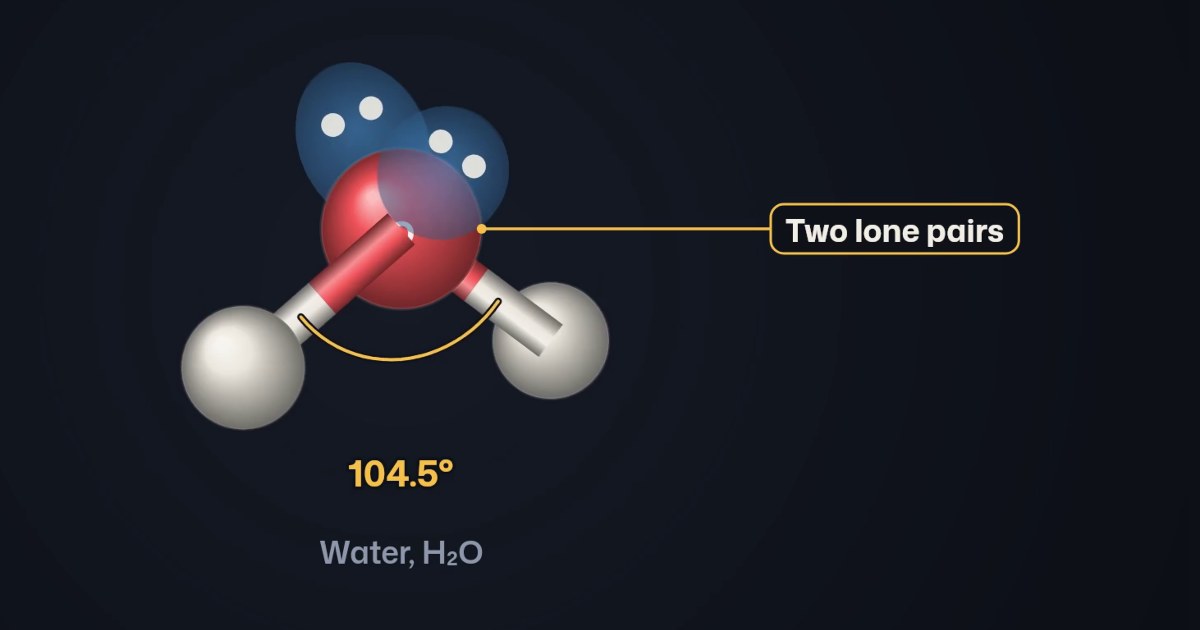
Accuracy matters more in chemistry than in most subjects, because the errors are small and look plausible: a hydrogen too many, a charge on the wrong atom, a coefficient that almost balances, a bond angle drawn at 120° instead of 104.5°. General AI video tools draw molecules as pictures, and a picture of a molecule can be wrong in ways a student will not spot and a teacher will spot at once.
So a chemistry animation should be built from the chemistry, not drawn freehand: the structure worked out from the formula with every valence checked, the equation balanced by calculation, each mechanism step checked electron by electron, the shape from the electron pairs around the central atom, the titration curve from the real acid and base.
How do you make one with Chasca?
Chasca’s Visual chemistry skill makes this kind of video from a topic, a question or your own script:
- The three levels, linked: molecules in 2D (skeletal, displayed and Lewis formulas) and in 3D (ball-and-stick and space-filling), particles in a box, equations with an atom count, the periodic table coloured by real data, titration curves and lab set-ups, each change on the words that describe it.
- Computed, never sketched: structures worked out from their formulas and checked for impossible bonds, equations balanced by calculation, VSEPR shapes with their real angles and lone pairs, titration curves and cell voltages calculated.
- Curly arrows that move electrons: every step is checked atom by atom, then the bonds break and form and the atoms glide to their new places.
- Time for the click: the narration pauses while the important change happens.
- Checked before you share it: the script is read against the chemistry, and if something needs a look, the video’s page says where.
- Any of 79 languages, with formulas and equations as chemists write them everywhere and Arabic words right to left.
The video at the top of this page is a one-minute example: why the water molecule is bent, with its two lone pairs and its 104.5° angle.
It explains ideas rather than solving worksheets. For exam questions worked line by line with units, use Science problems, and pair the two: the idea first, then the practice. For the tools people compare it with, see the best chemistry animation video tools.
Your first two videos are free, up to a minute each, watermarked and with no card required. Plans start at $9.99 a month (pricing).
Sources
- Johnstone, A. H. (1991). Why is science difficult to learn? Things are seldom what they seem. Journal of Computer Assisted Learning, 7(2), 75–83.
- Gabel, D. (1999). Improving teaching and learning through chemistry education research: A look to the future. Journal of Chemical Education, 76(4), 548–554.
- Williamson, V. M., & Abraham, M. R. (1995). The effects of computer animation on the particulate mental models of college chemistry students. Journal of Research in Science Teaching, 32(5), 521–534.
- Ardac, D., & Akaygun, S. (2004). Effectiveness of multimedia-based instruction that emphasizes molecular representations on students’ understanding of chemical change. Journal of Research in Science Teaching, 41(4), 317–337.
- Tasker, R., & Dalton, R. (2006). Research into practice: Visualisation of the molecular world using animations. Chemistry Education Research and Practice, 7(2), 141–159.
- Höffler, T. N., & Leutner, D. (2007). Instructional animation versus static pictures: A meta-analysis. Learning and Instruction, 17(6), 722–738.
- Bhattacharyya, G., & Bodner, G. M. (2005). “It gets me to the product”: How students propose organic mechanisms. Journal of Chemical Education, 82(9), 1402–1407.
- Grove, N. P., Cooper, M. M., & Rush, K. M. (2012). Decorating with arrows: Toward the development of representational competence in organic chemistry. Journal of Chemical Education, 89(7), 844–849.
Questions people ask
Because it is explained on three levels at once: what you can see in the lab, the particles you cannot see, and the symbols that stand for them. Alex Johnstone's work showed that students are asked to move between the three far more quickly than they can, and many never connect the symbols to the particles.
Mostly, yes, when they show the particles doing what the explanation says. College students who watched animations of particles built better particle models than those who did not, and eighth graders taught with molecular animations beside real observations outperformed classmates taught the usual way. The effect lasts longer when students are asked to link the animation to the symbols.
Many treat them as decoration: they draw the product they remember and add arrows afterwards, instead of using the arrows to work out where electrons go. An animation that moves a pair of electrons and then breaks and forms the bonds it describes shows the arrow as the cause of the change.
Chasca's Visual chemistry skill makes one from a topic, a question or your own script: molecules worked out from their formulas and drawn in 2D or 3D, curly arrows checked electron by electron, equations balanced by calculation with an atom count, particles, the periodic table and titration curves, narrated in your language.
Yes. The skill narrates in any of Chasca's 79 languages, with the words on screen in that language; formulas and equations stay as chemists write them everywhere.